

Engaging all five senses while eating—often called Sensory Eating—transforms a routine task into a grounding, meditative experience. It shifts the focus from just “refueling” to a full-bodied appreciation of the meal.

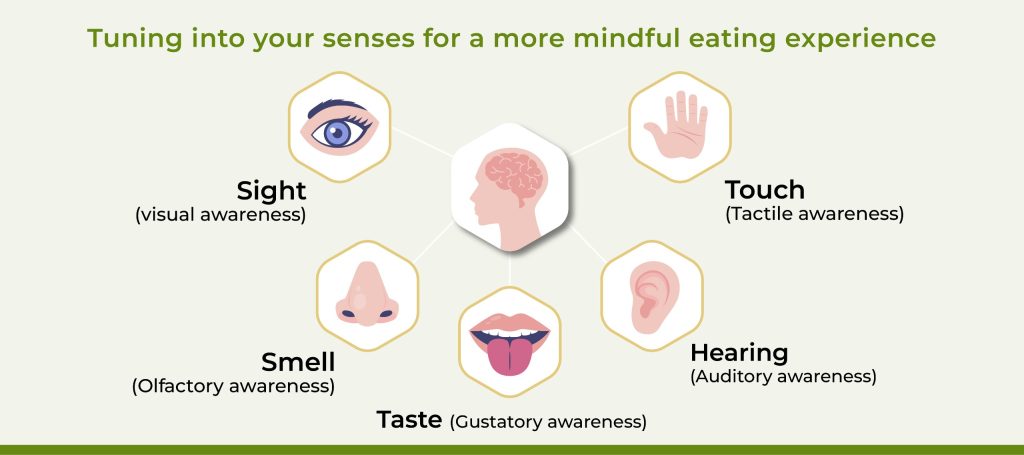
Here is how to activate each sense during your next meal:
1. Sight: The First Taste
Before you even pick up a morsel, let your eyes “eat” first. Visual stimulation triggers the cephalic phase of digestion, signaling your stomach to begin producing enzymes.
- Color & Contrast: Notice the variety of hues on your plate. A vibrant mix of greens, deep reds, or earthy browns creates a visual landscape.
- Form & Geometry: Observe the shapes—the rough edges of a crusty bread, the smooth curve of a sliced fruit, or the steam rising in delicate patterns.
2. Touch: Texture & Temperature
This involves both the feel of the food in your hands (if appropriate) and the “mouthfeel.”
- Surface Tension: If eating with your hands, feel the grain of the rice or the coolness of a leaf.
- Mouthfeel: Once the food is in your mouth, notice the architecture. Is it creamy, crunchy, fibrous, or silken? Pay attention to how the texture changes as you chew.
- Thermal Sensation: Notice the contrast between a warm soup and a cool garnish, or how a spice creates a physical sensation of heat.
3. Smell: The Essence of Flavor
The nose is responsible for up to 80% of what we perceive as “flavor.”
- Initial Aroma: Lean in and take a deep breath before the first bite. Try to identify individual notes—is it nutty, floral, citrusy, or pungent?
- Retronasal Olfaction: As you chew, air is pushed from the back of your mouth into your nasal cavity. This is when the “bouquet” of the food truly unfolds.
4. Hearing: The Soundtrack of the Meal
Sound is the most overlooked sense in eating, yet it provides essential feedback about freshness and preparation.
- Preparation Sounds: Listen to the sizzle of a pan or the rhythmic sound of a knife on a cutting board before the meal begins.
- Active Sounds: Focus on the “crunch” of a fresh vegetable, the “snap” of a cracker, or the soft “slurp” of a warm liquid. These sounds reinforce the brain’s perception of texture.
5. Taste: The Final Frontier
While we often think of taste as one thing, it is actually a combination of five distinct signals detected by the tongue.
- The Big Five: Try to identify where on your tongue you feel Sweet, Sour, Salty, Bitter, and Umami (savory).
- The Evolution: Notice how the taste changes from the moment it hits your tongue to the moment you swallow. Does a bitter note linger? Does a sweetness emerge after chewing a complex carbohydrate?
Tips for Practice
- The Three-Bite Rule: If a full sensory meal feels overwhelming, try applying this focus to just the first three bites of your meal.
- Minimize Distractions: Put away phones and screens. External noise often “mutes” our internal sensory receptors.
- The “Silent” Meal: Try eating in silence for five minutes to allow the subtle sounds and smells of the food to take center stage.